
 starting so late in life and being untrained, my work will always look naive. with a blind optimism, and sympathy to religion, belief in some sort of noble aspects to man, life and death -- away from cynicism, the unaesthetic and meaninglessness, i will probably never fit into any contemporary art scene. i would just like to continue to paint and have these little hidden away shows. to be seen and not seen. selling work is not really a priority, and becoming any sort of spectacle is very unappealing. the only thing i'm interested in being right now with my art is relevant.
Sunday, April 17, 2011
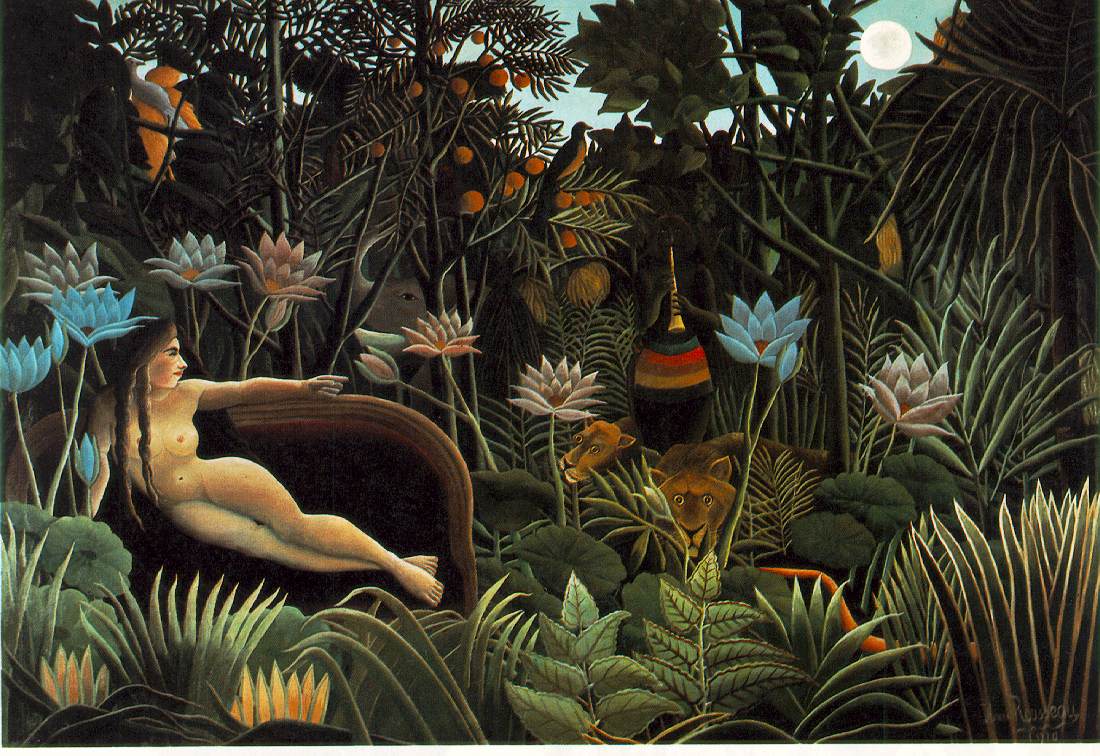
henri rousseau [aka self-analysisII]
starting so late in life and being untrained, my work will always look naive. with a blind optimism, and sympathy to religion, belief in some sort of noble aspects to man, life and death -- away from cynicism, the unaesthetic and meaninglessness, i will probably never fit into any contemporary art scene. i would just like to continue to paint and have these little hidden away shows. to be seen and not seen. selling work is not really a priority, and becoming any sort of spectacle is very unappealing. the only thing i'm interested in being right now with my art is relevant.

Tuesday, April 5, 2011
Sunday, April 3, 2011
i know you want to hide all the time, but that just didn't work out
"zeeny, eclecticism, hybridity. the optimism of those ideas! the certainty on which they rested: of will, of choice! but zeeny mine, life just happens to you: like an accident. No: it happens to you as a result of your condition. Not choice, but - at best - process, and, at worst, shocking, total change. Newness: he had sought a different kind, but this was what he got."
Friday, April 1, 2011
'the morning hours'
in the name of God, beneficent, merciful 1. by the morning hours 2. and by the night when it is stillest 3. your Lord has not forsaken thee, nor does He hate thee 4. and verily the latter portion will be better for thee than the former 5. and verily thy Lord will give unto thee so that thou wilt be content 6. did He not find thee an orphan and protect [thee]? 7. did He not find thee wandering and direct [thee]? 8. did He not find thee destitute and enrich [thee]? 9. therefore, the orphan oppress not 10. the beggar drive not away 11. therefore of the bounty of thy Lord be thy discourse
Saturday, March 26, 2011
basquiat - radiant child film
"Inverse asceticism, apparently, is PC-speak for addiction." [this is not from the movie]. the most interesting part is his crossing out letters, words, items. so the art world tried to make him into an other, caged, wild pet.
Thursday, March 24, 2011
"...and all this explaining is tedious" [unlike when making art]
Julian Schnabel's 'miral', one minute interview.
Monday, March 21, 2011
language of art lecture [notes]
the view of old european immigrants.
art itself is not a language but an insight. the truth is not told, it is shown. it's purpose is the improvement of human experience. it is not didactic. when philosophy fails, use poetry. it can serve a revolution and be propaganda. it is the quality and not the literal content or the colour arrangement that compels. art has her own language - a silent language - but is not a language herself]. it involves meticulous execution and colour choosing.
the self is a limited universe. in midieval art, there was communication without effort and artists were teachers. the eastern european saint icon was a window of communication. renaissance art was true to life and had depth and volume. in the 19th century the pre-raphaelites had a language of flowers. so did manet. lemon=sour disposition; mirror=vanity or self-knowledge. the reformation killed the renaissance. the counter reformation was an uncreative period with church propaganda. the ecstasy of st. terese. [exception to the otherwise mediocre].
art of 1600s Holland read like a book with the sophisticated bourgeois. the 1900s bourgeois academic painting told short stories and anecdotes, until the impressionists arrived. the pre-raphaelites exhibited passionate emotion restricted by victorian culture and was rich in symbolism. rosetti painted elizabeth, and jane morris as narcisstic beauties.
art improves our skill in handling the world.
impressionists caught contemporary life. lower, middle class girls - a new emerging class - who could spend on leisure. 1860s france - joie de vie. manet painted the scandalous 'olympia'. 'nana'. clear language. ridiculed for painting a contemporary kept woman.
baudelaire said that the artist creates a universal language. work, suffering, gift. art is always in opposition to its predecessor.
now: language has fallen through, where only the ego remains, and critics are left to speak.
cezanne can express ideas in colour. can drink it. can lose yourself in it. there was a new way to perceive nature. a new literacy that was away from the academy. the louvre shows us the dictionary. how do we develop our language skills of art? by comparing, comparing, comparing.
every great artist invents a new language in opposition to themaster and to the current scheme of things. interpreting every aspect of reality. the artist creates a new scheme of things.
Subscribe to:
Posts (Atom)